🏬Supersize Online Funeral Retailer🪦1000's of Headstones⚱️Over 10,000 Cremation Urns⚰️Caskets Overnight Delivery🛒Funeral & Memorial Superstore🚚FREE Shipping on ALL Orders👨👩👧👦Helping Families for over 20 Years💰Lowest Price Guarantee🏬Supersize Online Funeral Retailer🪦1000's of Headstones⚱️Over 10,000 Cremation Urns⚰️Caskets Overnight Delivery🛒Funeral & Memorial Superstore🚚FREE Shipping on ALL Orders👨👩👧👦Helping Families for over 20 Years💰Lowest Price Guarantee
🏬Supersize Online Funeral Retailer🪦1000's of Headstones⚱️Over 10,000 Cremation Urns⚰️Caskets Overnight Delivery🛒Funeral & Memorial Superstore🚚FREE Shipping on ALL Orders👨👩👧👦Helping Families for over 20 Years💰Lowest Price Guarantee🏬Supersize Online Funeral Retailer🪦1000's of Headstones⚱️Over 10,000 Cremation Urns⚰️Caskets Overnight Delivery🛒Funeral & Memorial Superstore🚚FREE Shipping on ALL Orders👨👩👧👦Helping Families for over 20 Years💰Lowest Price Guarantee
It's critical to keep in mind that your presence at a funeral is to support and honor the departed person's family. You'll be better prepared and more at ease at a funeral ceremony if you know the proper funeral etiquette. This article highlights various funeral and memorial etiquettes you should know. For a broader look at the entire process, our guide to funeral planning walks families through every step from start to finish.
1. Who can go to a funeral?
A funeral service is often open to everyone unless the family has declared explicitly that it is a private ceremony. Private funerals are usually open only to family members, friends, those who knew the deceased, and any other invited guests. It allows them to pay their last respects to the dead.
If the funeral is not private, then anyone can attend. However, you should always consider your relationship with the deceased before deciding whether or not to attend. You should attend a funeral if you are one of the following.
The deceased's kin.
The deceased family member or friend.
Friend of the deceased
Friend of the family of the deceased.
The deceased coworker or family member's superior.
Members of the same congregation, synagogue, or other religious groups.
If the deceased family member is a member of the same organization as you.
A client or customer of the dead person's business or family.
Who shouldn't attend a funeral?
Illness or physical restrictions: You shouldn't go to the funeral if you are sick or feel like you might get sick. This is particularly valid if you're contagious. The family's last need after a loss is for them to get sick. Think about how the service will be interrupted if your illness worsens during the funeral.
Controversial or disruptive presence: You shouldn't attend the funeral if your attendance would cause conflict, commotion, pain, or disruption for any family member. The family and their demands are at the center of funeral etiquette.
Kids (sometimes): If you have young children, you might decide that leaving them with a nanny or relative is the best option. Asking kids to act appropriately at a funeral can be difficult and upsetting.
2. How to dress for a funeral
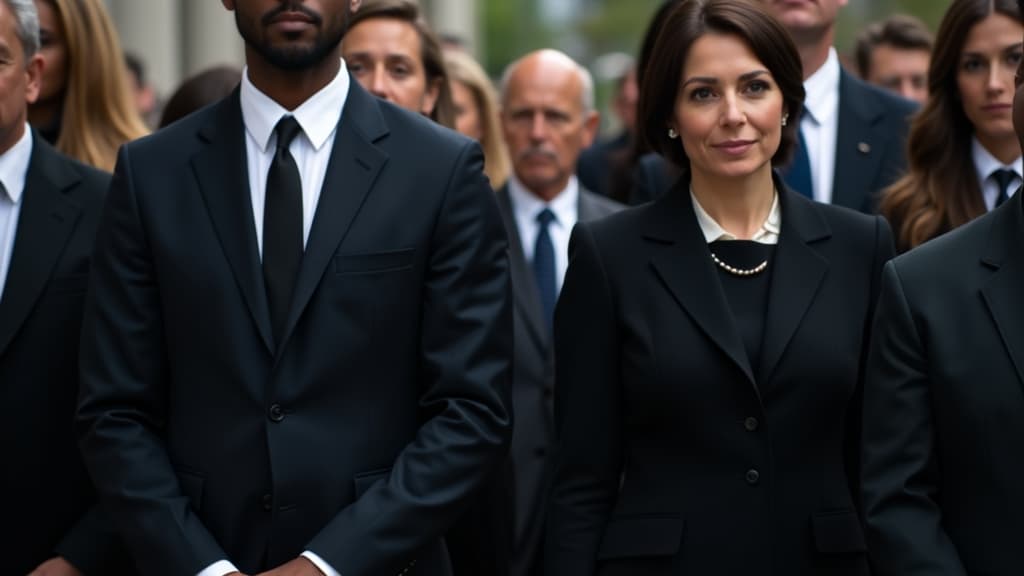
The most typical funeral attire is black or a dark color. However, certain cultures demand that mourners wear something else. The short version is below; what to wear to a funeral is the long one, including the services where the old rules still hold and the ones where they no longer do.
The relatives of the deceased may want you to wear less formal clothing if you attend a celebration of life, woodland burial, or funeral in a location other than a house of worship or crematorium.
They might ask you to wear something less formal, or they might have a specific theme they'd like you to follow.
How should women dress for a funeral?
A skirt or dress is typically worn with tights. These should be knee-length, plain, and neither flamboyant nor exposing.
A pair of classy pants: funerals are not the place for jeans or other casual pants. An elegant pair of ankle-grazer or full-length pants in a dark color can be an excellent choice.
Cardigan, blazer, or sweater: It's a good idea to bring an extra layer if it's winter or the venue is cold. A blazer can also dress up a more laid-back ensemble. A graveside service in January is a different problem again — what to wear to a winter funeral covers coats, boots and standing on frozen ground for twenty minutes.
A sophisticated blouse or top can be worn with a skirt or pair of pants if you wear a plain blouse or top. There shouldn't be any bright colors or patterns; it should be restrained and simple.
The stylish jumpsuit is a growing trend, mainly because they might be more comfortable for longer services.
Avoid hats, bright jewelry, exposing attire, and jeans.
How should men dress for a funeral?
Wear smart dark or black suits, which can be paired with a long-sleeved white shirt and a tie.
Smart pants with a plain white t-shirt and a blazer are a bit more relaxed but still an appropriate option if you don't own a classic suit.
Plain black tie: While this is often optional, it is advised if you wish to look particularly elegant.
Shiny black shoes – formal shoes are typically the preferred option in tradition, but any classy shoes are fine.
Avoid jeans, t-shirts with short sleeves, sneakers, and hats or beanie hats.
What clothes should kids wear to funerals?
When it comes to kids, there is a little more latitude. Smart, age-appropriate attire is preferred, and funeral clothes for kids goes further by age, including what to do about a growing child who has nothing that fits. This can comprise of:
Dark-colored pants, a simple blouse, and a sweater.
A cardigan, a plain-colored shirt, and a dark skirt.
Smart attire.
Classy black or dark shoes, etc.
3. How to speak during a funeral
Even though you might feel awkward speaking to the deceased's family at a funeral, expressing your sadness for their loss is always appropriate.
You only need to say a few friendly and empathetic words calmly, and you may even share a pleasant memory of the individual if you choose. It's crucial to avoid being critical or trivializing the person's passing.
What to Say to Those Grieving during a Funeral
You will likely greet and have a brief conversation with the deceased's loved ones when you attend a funeral. It might be challenging to decide what to say and what is inappropriate. Consider using salutations or conversation starters like:
• Please know that (deceased's name) will always hold a special place in my heart and that I am sincerely sorry for your loss.
• Hello, I'm glad to see you here as we honor the wonderful life of (deceased's name).
• I'm very sorry you had to deal with this. I'll never forget the contagious laugh and people-persona of (deceased's name).
• (Deceased's name) will always be in my heart.
What to say when asked to speak at a funeral
You may be asked to speak at a funeral; words might fail if you are unprepared. These tips can help.
Include poetry and proverbs: During your eulogy, you could perhaps read a few funeral poetry or quote a few of the deceased's favorite prayers or sayings. If you'd like, make copies of the poems and distribute them as souvenirs at the service. Keep in mind that readings at memorial services are frequently brief and emotional.
Personalize your statements: Instead of using clichés or talking about your own sadness, talk about the fantastic memories you have of the departed.
Write down your speech: Spend some time gathering your ideas. Obtain inspiration from the memories shared by friends and family. For inspiration, you can also look at old pictures, movies, or letters. Use all of this inspiration to write honestly. Create rough drafts and write your conclusions on note cards that will fit in your pocket or handbag.
4. Where to sit at a funeral
It's normal to experience anxiety when choosing a memorial or funeral service seat. For example, some individuals worry that sitting very close to the bereaved family an imply too much intimacy. In contrast, others fear that sitting too far can express a feeling of isolation or isolate the family.
Remember that the most crucial aspect of seating during a funeral or memorial ceremony is ensuring that family members and close friends have a place to sit in the front and aren't forced to dispute or haggle over a seat. At the same time, there shouldn't be empty seats all around people seated up front.
It's usually better to sit at the front, and if you have the mobility to shift, you can consider offering your seat to someone who needs one. This not only shows consideration but can also bring together strangers who have experienced the same loss and help diffuse tense situations.
The first several rows of seats are often reserved for family members solely with immediate family members (including spouses or significant others) seated in the first row and then members of the extended family sitting behind them.
There are no other specific seating requirements for funerals or memorial services besides these generic seat arrangements. You should consider sitting closer to the front, if the venue is huge to help the atmosphere feel more intimate. You should feel at ease standing in the back, leaning against a wall, or occupying any open seats if there are many attendees and there aren't enough seats.
On the other hand, if there is space and a straightforward way to get to the seat without interfering with the ceremony, it is usually a good idea for you to move over and provide your support if you are close to someone who is grieving severely and who could be struggling more than others.
5. What should I bring to a funeral?
Giving the grieving family a bouquet of sympathy flowers is a thoughtful way to convey your sympathy gifts and would be greatly appreciated. You can either choose to have a flower brought to the funeral home in advance or bring one with you to the service. You can also deliver flowers to the home where the post-funeral reception will be held.
Sending a gift basket to the family's home is another kind of present suggestion. If you're related to the family, think about giving them a handmade meal. Losing a loved one is difficult enough, so the deceased's family or spouse would likely welcome any additional assistance. A thoughtful card is a beautiful approach to console the family if you aren't close to them but still want to express your sorrow. Many families also distribute memorial cards during the service as a printed keepsake honoring the person who passed.
6. How much should one donate to a funeral?
You should abide by the request if someone asks for donations to a charity instead of flowers. At the very least, you should consider donating what you would have spent on flowers.
You might want to send a card to the deceased's family and friends and a note to the charity or association.
There are many factors you should take into account before donating. Knowing where the money is going will help you determine how much you feel you can spare. You should also think about your personal financial status. Here are some specific questions and things to think about.
Who is getting the funds? Everyone wants to think the best about others. But regrettably, some people will abuse others' kindness. Make sure the individual collecting money for an online fundraiser is allowed to do so before you donate. Unauthorized individuals have in the past created fundraising accounts for high-profile funerals and pocketed the funds. If you don't know the people hosting the event, do your research before donating.
What will the money be used for? Where monies are going may affect how much money you donate. If the money would go toward paying for the deceased's funeral or the needs of the remaining family members, you could opt to donate more. If the donation is going to a charity you don't support; you could want to give less.
7. Do you need to go to the funeral home to see the deceased?
While paying a visit to a loved one at the funeral home can be very upsetting, some people find that it can bring them closure by letting them know that their loved ones are now at peace. You should ask the person organizing the funeral if you want to visit. This service is often only afforded to family and close friends. If you're unsure what to expect at a viewing, our guide explains the difference between a wake and funeral and how each type of service works.
8. What should I do at the graveside service?
Avoid stepping directly on other graves, memorial stones, or plaques as you make your way to the graveyard.
You will find chairs set up at the graveside memorial once you arrive. These may only be available to the deceased person's immediate family. If you are not one of them, move back behind the chairs to make a place for other relatives or close friends to stand close to the grave.
9. Should kids go to funeral services?
Children are welcome at funerals unless the grieving family explicitly requests otherwise. Asking your older children if they want to go is essential if they are old enough. Talking to them about what will happen at the funeral and how they might feel can be helpful.
Consider your child's relationship with the deceased, their knowledge of the funeral, and how the mourning family would feel if your child became fussy. Younger children and babies may find sitting quietly for the funeral service complex.
A nursing or new baby may not be able to be left at home. In this situation, if your baby starts to fuss, you could sit close to an exit and leave. Alternatively, you may ask someone to come along with the specific purpose of watching your child while the service takes place.
10. Attending funerals of other religions
The purpose of attending a funeral is to pay your respects to the deceased, which can be accomplished by simply paying attention to the service and showing courtesy to the other mourners.
There is no obligation for you to participate in any religious practices that you are unfamiliar with or uncomfortable with if you are attending the religious service of someone whose religious beliefs differ from your own.
11. Can I use my smartphone during a funeral service?
Kindly put your cell phone away and be on silent for the majority of the service. Using your phone at such a sensitive time is inappropriate because the grieving family may view it as an invasion of their privacy. Step outside if you really must respond to a text or take a call.
12. Can I take photos at the funeral?
As with any significant event in life, there can be a strong desire to record the experience with images, especially if you're meeting up with old acquaintances and relatives. However, it's best to refrain from taking any pictures at a funeral unless a close relative of the dead gives you the go-ahead. This includes taking selfies, which could be seen as disrespectful by the deceased person's relatives.
When taking pictures during a funeral, if you have been given permission, be discrete in your approach, turn off the flash, and make sure to ask those you want to snap. The best time to take a photo is usually right after the funeral service when you are outside and away from the other mourners.
Always follow the example set by the deceased's family and refrain from putting anything online until they have done so. Simply leaving a meaningful condolence message on a post that a family member has already shared is often the most courteous way to interact on social media.
A simple funeral or memorial service etiquette is to avoid posting during the service altogether. Although you might be tempted, it would be disrespectful, and a violation of the family's right to privacy to "check in" or discuss the funeral on your social media profiles.
14. What happens when a funeral or memorial service is completed?
The minister will leave after the ceremony, and everyone will stand to offer their respects. Afterward, the coffin will either be carried out, lowered, or covered by a curtain, depending on the service.
Loved ones can say their final goodbyes by viewing the casket before they go. The remainder of the mourners will leave after the immediate family and close friends. If the funeral involves a burial, the coffin will be brought to the grave and then lowered into the ground.
If the family hosts a reception afterward, understanding funeral food traditions can help you decide what to bring or what to expect at the gathering. Etiquette extends well beyond the service itself, and knowing what happens during a funeral visitation beforehand can also help you feel more prepared.