🏬Supersize Online Funeral Retailer🪦1000's of Headstones⚱️Over 10,000 Cremation Urns⚰️Caskets Overnight Delivery🛒Funeral & Memorial Superstore🚚FREE Shipping on ALL Orders👨👩👧👦Helping Families for over 20 Years💰Lowest Price Guarantee🏬Supersize Online Funeral Retailer🪦1000's of Headstones⚱️Over 10,000 Cremation Urns⚰️Caskets Overnight Delivery🛒Funeral & Memorial Superstore🚚FREE Shipping on ALL Orders👨👩👧👦Helping Families for over 20 Years💰Lowest Price Guarantee
🏬Supersize Online Funeral Retailer🪦1000's of Headstones⚱️Over 10,000 Cremation Urns⚰️Caskets Overnight Delivery🛒Funeral & Memorial Superstore🚚FREE Shipping on ALL Orders👨👩👧👦Helping Families for over 20 Years💰Lowest Price Guarantee🏬Supersize Online Funeral Retailer🪦1000's of Headstones⚱️Over 10,000 Cremation Urns⚰️Caskets Overnight Delivery🛒Funeral & Memorial Superstore🚚FREE Shipping on ALL Orders👨👩👧👦Helping Families for over 20 Years💰Lowest Price Guarantee
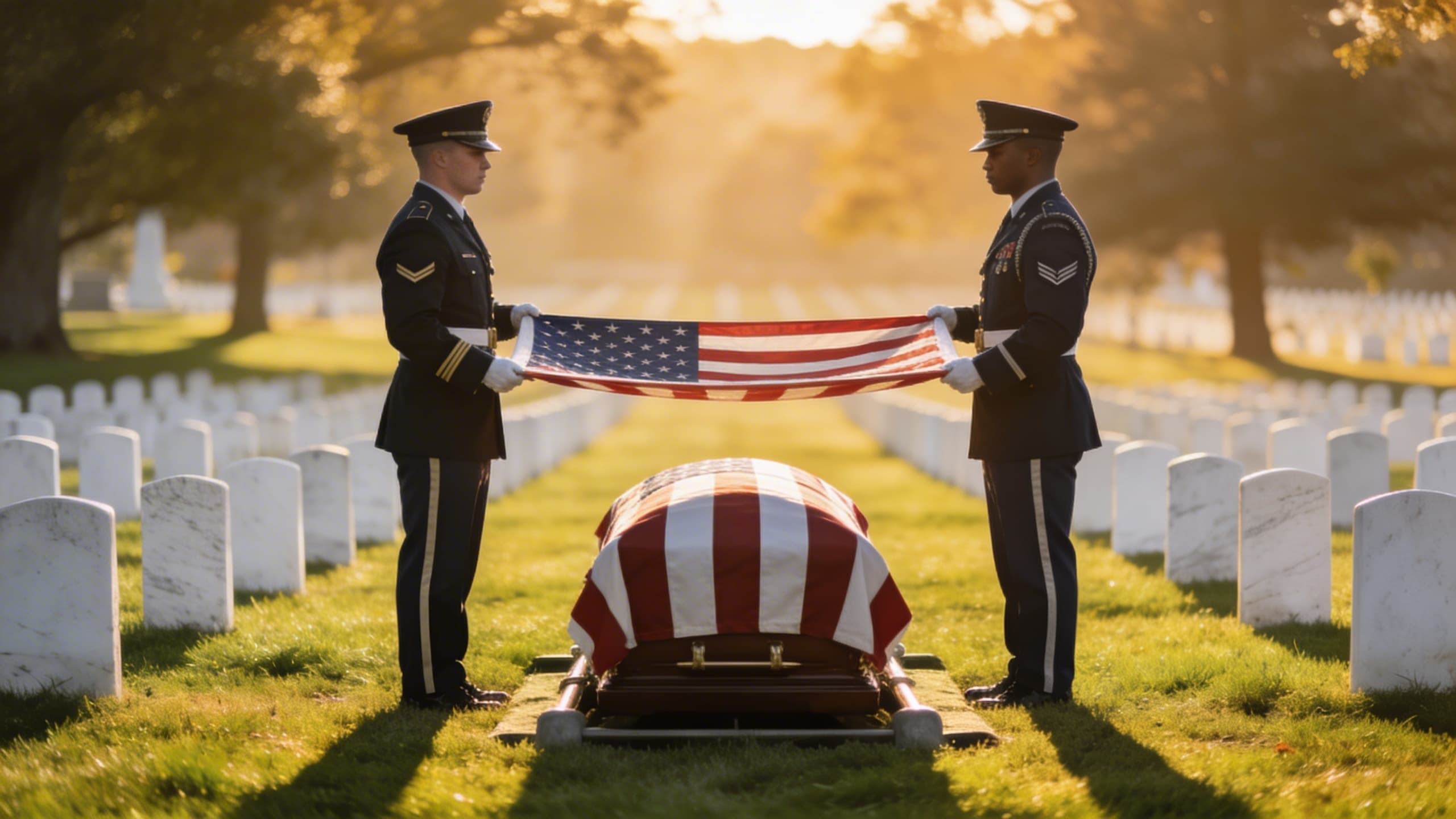
When a veteran or active-duty service member passes away, military funeral honors provide a powerful tribute to their sacrifice. The flag ceremony — from draping the casket to folding and presenting the flag to the family — is one of the most meaningful elements of these services. For families preparing for this moment, understanding military funeral flag etiquette can bring comfort during an incredibly difficult time. For a broader look at the honors, benefits, and memorial products available to military families, see our military memorial guide.
This guide covers everything families need to know: how the flag is placed on the casket, the significance of each fold, who receives the flag, whether you can unfold it afterward, and how to display and care for your veteran's burial flag.
The U.S. Department of Veterans Affairs provides a burial flag at no cost for veterans who meet specific service requirements. Eligibility extends to:
Veterans who served during wartime or peacetime and were honorably discharged
Active-duty service members who die during their service
Selected Reserve members who meet specific criteria
Veterans who completed at least one enlistment before June 27, 1950, or were discharged due to a service-connected disability
The key disqualifier is a dishonorable discharge. Rank, branch, and whether the veteran served in combat are generally not factors — military funeral eligibility is based on honorable service, not rank or combat history.
To obtain a burial flag, families or funeral directors fill out VA Form 27-2008 (Application for United States Flag for Burial Purposes). Flags are available at VA regional offices and most U.S. Post Offices. Only one flag is provided per eligible veteran.
How the Flag Is Placed on the Casket
The tradition of draping a flag over a fallen service member's casket dates back to the Napoleonic Wars of the late 1700s, when flags were used to identify soldiers on the battlefield. Today, this practice honors the veteran's service and sacrifice rather than serving a battlefield function. For detailed flag placement on a casket, the protocol varies by casket type:
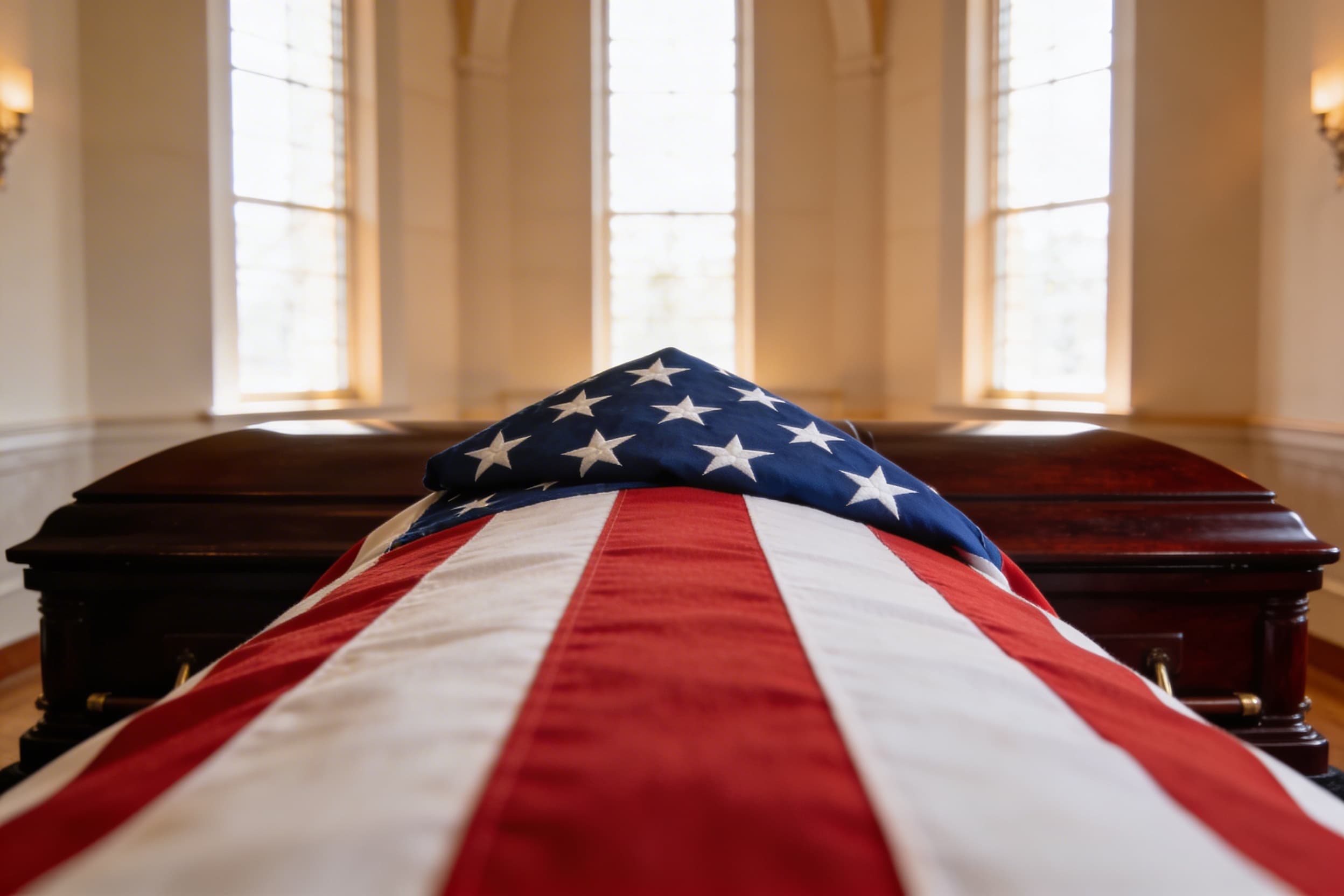
Closed casket: The union (blue field with stars) is placed at the head of the casket, over the deceased's left shoulder. The stars rest over the heart, symbolizing the nation's protection even in death. The flag should be stretched taut, with red and white stripes running lengthwise.
Half-couch casket (partially open): The flag is folded in three layers so that the blue field is the top fold, positioned next to the open section of the casket on the deceased's left side.
Full-couch casket (fully open): The flag is folded into a triangle and placed in the center of the head panel, above the deceased's left shoulder.
Cremation: When an urn is used, the flag is already folded into its triangular military fold. The lead body bearer carries the folded flag to the right of the urn. After the urn comes to rest, bearers unfold the flag and hold it at pall height over the cremated remains. The remainder of the ceremony proceeds in the same manner as a casketed service.
At no point during the ceremony should the flag touch the ground. Pallbearers and honor guard members maintain control of the flag at all times.
Where the bearers are a military detail they will be in dress uniform and nothing is asked of the family. Where a family supplies its own bearers — common when a veteran is buried in a private cemetery — pallbearer attire covers what to wear to carry a casket, including gloves and the shoes that matter more than anything else on wet ground.
The Flag Folding Ceremony and the 13 Folds
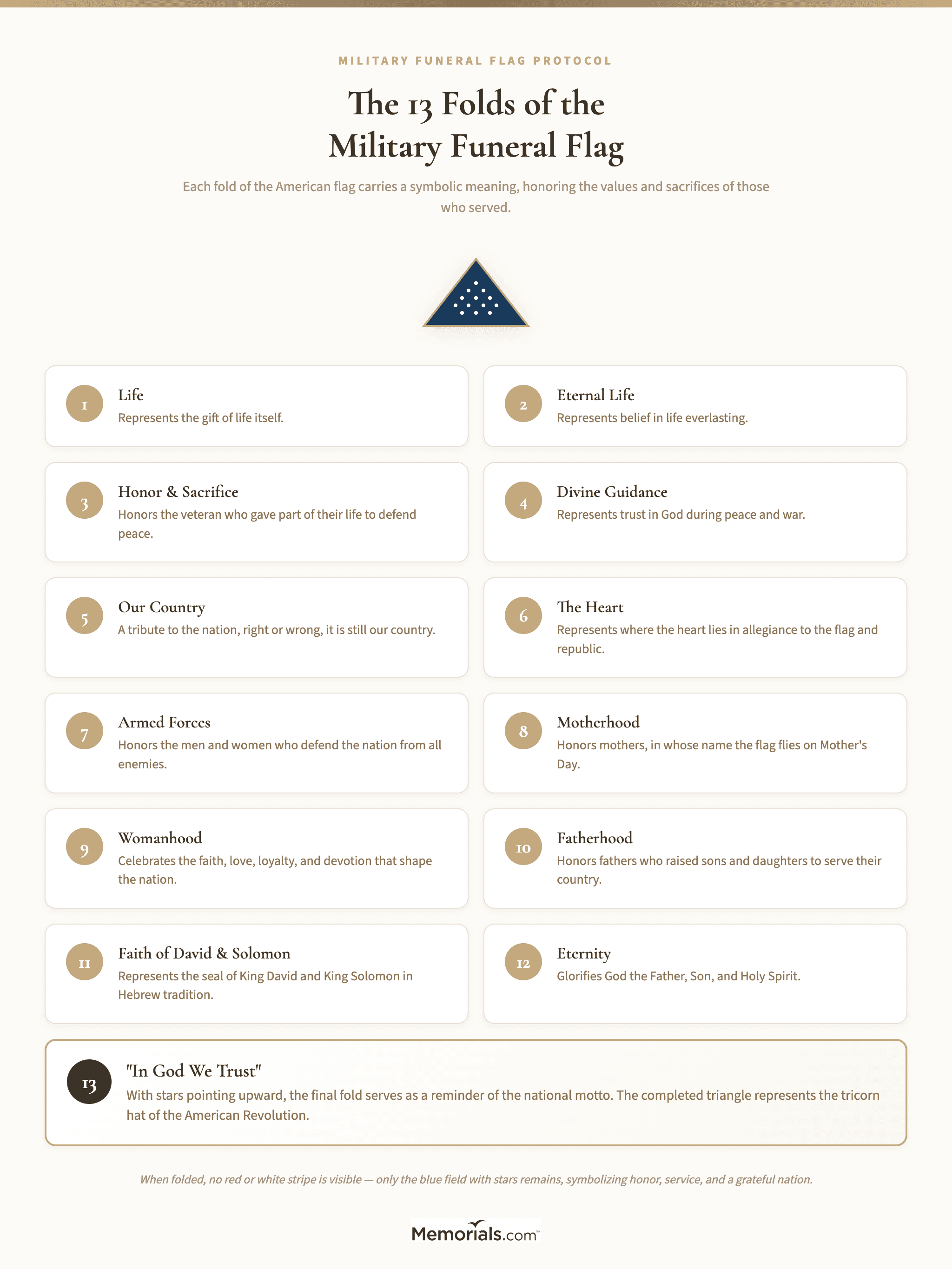
After the playing of Taps, the flag is carefully removed from the casket and folded into the symbolic tricorner shape — a form that represents the tricorn hat worn by patriots during the American Revolution. A properly proportioned flag folds 13 times along the triangles, representing the 13 original colonies. When folded correctly, no red or white stripe should be visible — only the blue field with white stars remains.
To learn more about the folding technique itself, including step-by-step instructions for families who want to practice beforehand, see our guide on how to fold a flag for display.
Each of the 13 folds carries a symbolic meaning:
First fold — Represents life
Second fold — Represents belief in eternal life
Third fold — Honors the departing veteran's sacrifice in defense of peace
Fourth fold — Represents trust in God for guidance in peace and war
Fifth fold — Pays tribute to the nation
Sixth fold — Represents the heart and the Pledge of Allegiance
Seventh fold — Honors the Armed Forces who defend the nation
Eighth fold — Honors mothers, in whose name the flag flies on Mother's Day
Ninth fold — Honors womanhood and the qualities of faith, love, and loyalty
Tenth fold — Honors fathers and their contributions to raising the nation's defenders
Eleventh fold — Represents the seal of King David and King Solomon
Twelfth fold — Represents eternity, glorifying God the Father, Son, and Holy Spirit
Thirteenth fold — With the stars pointing upward, serves as a reminder of the national motto, "In God We Trust"
The exact origin of these symbolic meanings is debated — some historians credit the Gold Star Mothers of America, others an Air Force chaplain at the U.S. Air Force Academy, and still others see the 13 folds as a tribute to the original colonies.
The Flag Presentation: Who Receives the Flag?
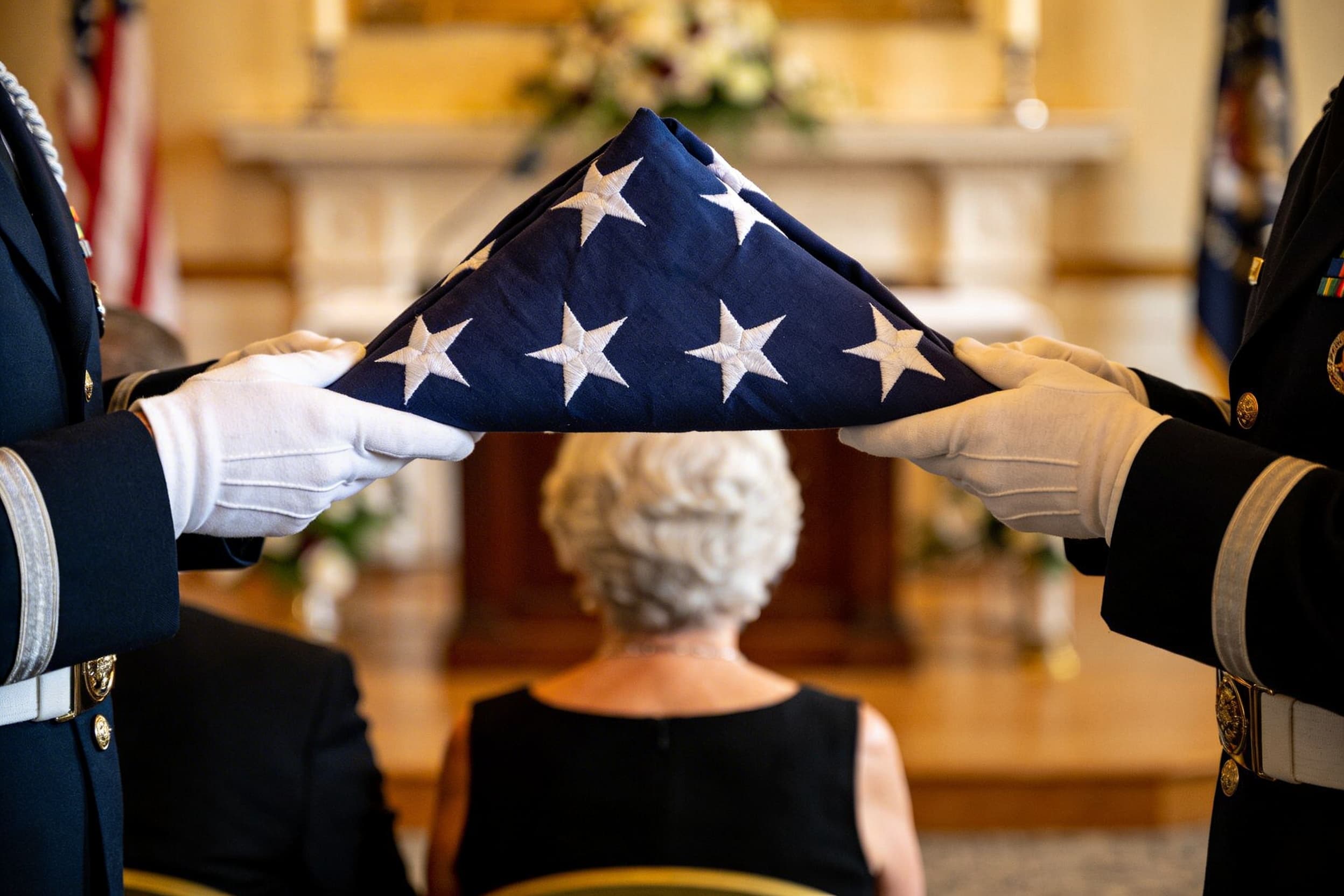
Once the flag is folded into its triangular shape, a uniformed representative from the veteran's branch of service presents it to the next of kin. Effective April 17, 2012, the Department of Defense standardized the presentation language across all branches:
Army: "On behalf of the President of the United States, the United States Army, and a grateful nation, please accept this flag as a symbol of our appreciation for your loved one's honorable and faithful service."
Navy: "On behalf of the President of the United States, the United States Navy, and a grateful nation, please accept this flag as a symbol of our appreciation for your loved one's honorable and faithful service."
Air Force: "On behalf of the President of the United States, the United States Air Force, and a grateful nation, please accept this flag as a symbol of our appreciation for your loved one's honorable and faithful service."
Marine Corps: "On behalf of the President of the United States, the Commandant of the Marine Corps, and a grateful nation, please accept this flag as a symbol of our appreciation for your loved one's honorable and faithful service."
Coast Guard: "On behalf of the President of the United States, the Commandant of the Coast Guard, and a grateful nation, please accept this flag as a symbol of our appreciation for your loved one's service to Country and the Coast Guard."
Who Gets the Flag at a Military Funeral?
This is one of the most common questions families face. The flag is presented to the deceased's designated next of kin. Active-duty service members typically designate their next of kin before deployment, so the decision is often already made.
If the designated next of kin has predeceased the veteran or no designation exists, the flag follows this order of precedence:
Surviving spouse
Children (oldest first)
Parents or legal guardian
Oldest grandparent
Siblings
Other relatives or close friends, consistent with the veteran's wishes or domicile documentation
If no claim is made by the next of kin, the flag may be given upon request to a friend or associate of the veteran.
Which Child Gets the Flag at a Military Funeral?
When a veteran has multiple children and no surviving spouse, the eldest child is the default recipient under military protocol. However, families can make arrangements beforehand to designate a different child if circumstances warrant — for example, if one child was the primary caregiver or has a closer connection to the veteran's military service.
The important thing to know: only one burial flag is provided per eligible veteran. If multiple family members want a flag, the family can purchase additional flags independently through a funeral home, though these will not carry the same ceremonial significance.
What Happens to the Flag When the Recipient Dies?
The burial flag belongs to the person who received it at the funeral — it becomes their personal property. When that person passes away, the flag becomes part of their estate and does not automatically transfer back through the deceased veteran's family line. The recipient may give it away or bequeath it to anyone they choose during their lifetime. For a full look at your options — from display cases to donations to passing the flag along — see our guide on what to do with a burial flag.
Can You Unfold a Military Funeral Flag?
Yes. While many families keep the flag in its ceremonial triangular fold permanently, there is no law or regulation prohibiting you from unfolding it. The U.S. Flag Code does not specifically address burial flags after the ceremony, which means families have several options:
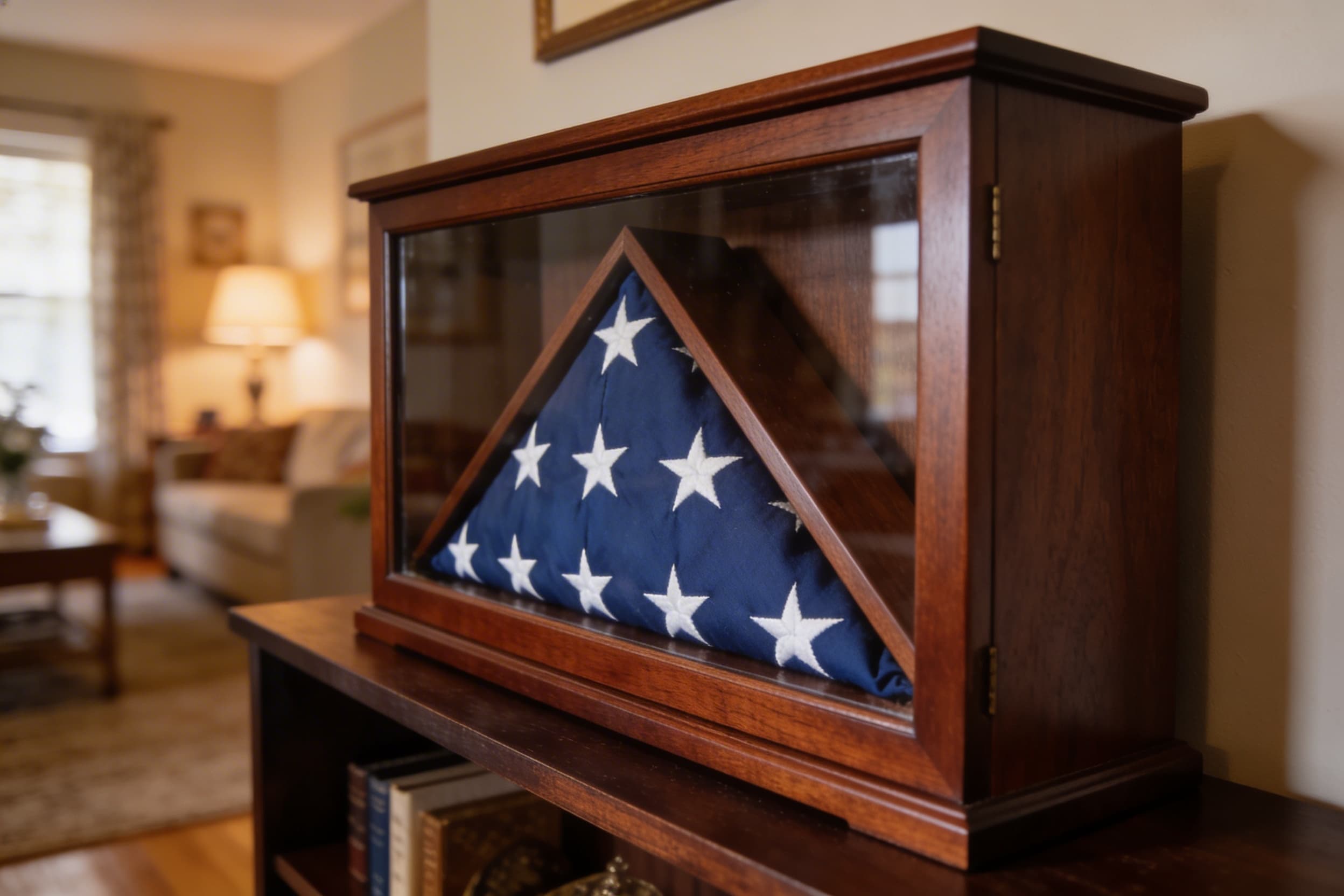
Keep it folded: Most families display the folded flag in a flag display case — a wooden case with a glass front that frames and protects the triangular flag. Many cases include a plaque for engraving the veteran's name and service dates, and some feature side compartments for medals and memorabilia. You can also find flag case accessories such as engraved nameplates and display lights to personalize the memorial.
Fly it from a flagpole: Because the burial flag measures 5 × 9.5 feet — nearly twice the size of a standard residential flag — you'll need a flagpole at least 20 feet tall to fly it properly.
Display it flat on a wall: Whether hung horizontally or vertically, the stars (union) should always be in the upper-left corner from the viewer's perspective.
Fly it on special occasions: Some families unfurl the burial flag on patriotic holidays like Memorial Day, Veterans Day, or the anniversary of the veteran's passing. For seasonal flag protocols, see our guide to Memorial Day flag etiquette.
Caring for and Storing the Burial Flag
To preserve the flag's condition over decades:
Avoid prolonged outdoor exposure. UV rays, moisture, and wind cause fading and fraying. If you fly the flag, bring it in during inclement weather.
Use acid-free storage. If storing the flag rather than displaying it, wrap it in acid-free tissue and place it in a clean, dry container.
Consider a flag display case. A quality case with UV-protective glass is the best way to preserve the flag while keeping it visible in your home.
If the flag becomes damaged beyond repair, it should be retired respectfully through a ceremonial burning. Many American Legion posts, VFW halls, and Boy Scout troops conduct flag retirement ceremonies and welcome community participation.
Do not return damaged flags to the VA — they cannot replace burial flags that are lost, destroyed, or stolen.
Does Flag Etiquette Apply to First Responder Funerals?
Flag draping protocols at police officer funerals trace their roots back to the Civil War, when veterans frequently joined local police departments after their military service. Today, many law enforcement agencies follow military flag etiquette at officer funerals, though the police chief typically has final authority over the ceremony's protocols.
Firefighters and emergency medical technicians may also incorporate flag ceremonies into their funerals, though these traditions are newer and still evolving. The underlying principle is the same: the flag honors a life of public service and sacrifice.
How the Flag Is Used for Notification of a Death in Service
When an active-duty service member is killed, military casualty notification officers deliver the news in person to the next of kin. The American flag is presented during this visit along with words acknowledging the service member's bravery and sacrifice. The military then works with the family to arrange the full funeral service, which includes the formal flag presentation ceremony.
Frequently Asked Questions
What size is a military funeral flag? The standard burial flag measures 5 feet by 9.5 feet — nearly twice the size of a typical residential flag. When folded into its triangular shape after the ceremony, it measures approximately 24 inches along the bottom, 16¾ inches diagonally, and 2¾ inches thick.
How do I apply for a veteran's burial flag? Complete VA Form 27-2008 (Application for United States Flag for Burial Purposes) and bring it to a VA regional office, a U.S. Post Office that stocks burial flags, or your funeral director. Most funeral homes handle this process for families automatically.
Can a non-veteran have a flag draped over their casket? Yes. Any patriotic citizen may request this honor, but the flag is not provided free of charge — the family must purchase it. During the service, it is appropriate to note that the flag represents the deceased's patriotism and love of country rather than military service.
Who pays for the burial flag? The VA provides one flag at no cost for eligible veterans. Additional flags or flags for non-veterans must be purchased by the family.
Can you display the burial flag outdoors? Yes, but take precautions against weather damage. Bring the flag inside during rain, snow, or high winds, and consider an all-weather flag if you plan to fly it regularly.
What should I do with a burial flag I no longer want to keep? You can donate it to a national cemetery with an Avenue of Flags, give it to a Veterans Service Organization, or pass it along to a friend or family member. Never dispose of a flag disrespectfully — if it's damaged, have it retired through a formal ceremony.