🏬Supersize Online Funeral Retailer🪦1000's of Headstones⚱️Over 10,000 Cremation Urns⚰️Caskets Overnight Delivery🛒Funeral & Memorial Superstore🚚FREE Shipping on ALL Orders👨👩👧👦Helping Families for over 20 Years💰Lowest Price Guarantee🏬Supersize Online Funeral Retailer🪦1000's of Headstones⚱️Over 10,000 Cremation Urns⚰️Caskets Overnight Delivery🛒Funeral & Memorial Superstore🚚FREE Shipping on ALL Orders👨👩👧👦Helping Families for over 20 Years💰Lowest Price Guarantee
🏬Supersize Online Funeral Retailer🪦1000's of Headstones⚱️Over 10,000 Cremation Urns⚰️Caskets Overnight Delivery🛒Funeral & Memorial Superstore🚚FREE Shipping on ALL Orders👨👩👧👦Helping Families for over 20 Years💰Lowest Price Guarantee🏬Supersize Online Funeral Retailer🪦1000's of Headstones⚱️Over 10,000 Cremation Urns⚰️Caskets Overnight Delivery🛒Funeral & Memorial Superstore🚚FREE Shipping on ALL Orders👨👩👧👦Helping Families for over 20 Years💰Lowest Price Guarantee
When you're responsible for making end-of-life arrangements, the number of decisions and costs can feel overwhelming. Direct cremation offers a simpler path — one that skips the formal funeral service and focuses on the cremation itself, often saving families thousands of dollars in the process. Our cremation planning guide walks through every option available, but this article focuses specifically on direct cremation: what it is, what it costs, how the process works, and what happens afterward.
What Is Direct Cremation?
Direct cremation — also called simple cremation or immediate cremation — is a type of disposition where the body is cremated shortly after death without a prior viewing, visitation, or funeral ceremony. There is no embalming, no purchase for display, and no formal gathering at a funeral home before the cremation takes place.
The body is transferred from the place of death (typically a hospital, nursing home, or private residence) to the crematory, where it is placed in a rigid, combustible alternative container rather than an expensive casket. Once the required paperwork and permits are secured, the cremation is performed. The cremated remains — commonly called ashes — are then returned to the family in a temporary container or in a cremation urn the family provides.
Direct cremation separates the act of cremation from memorialization. Families who choose this option can still hold a memorial service, celebration of life, or scattering ceremony at a later date — on their own schedule, in a location that feels meaningful.
How Much Does Direct Cremation Cost?
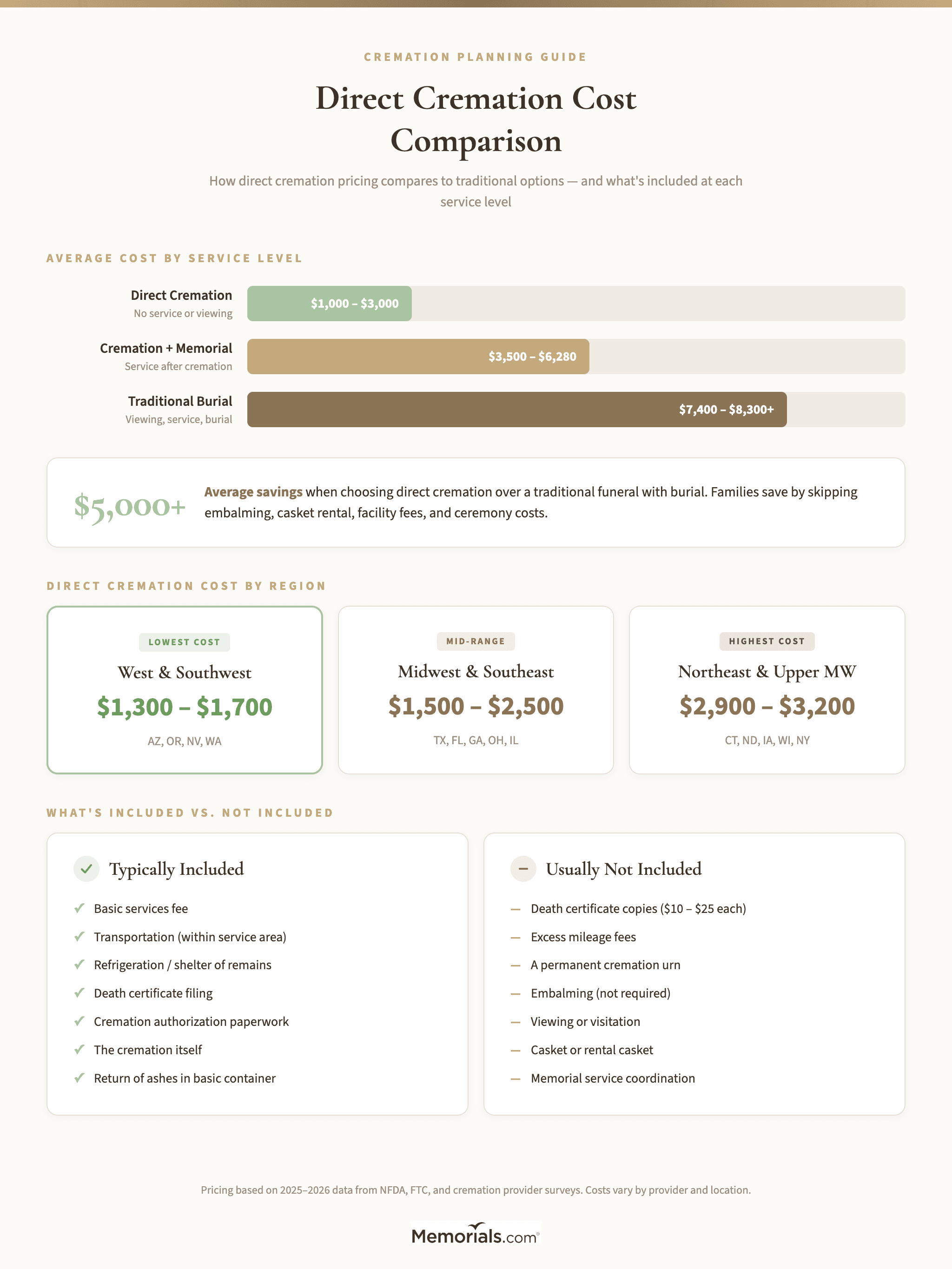
The cost of direct cremation ranges from roughly $1,000 to $3,000 depending on the provider and geographic location. The national average sits around $2,000 to $2,200 for a standard direct cremation package. By comparison, the National Funeral Directors Association (NFDA) reports that the median cost of a funeral with cremation is approximately $6,280, and a traditional funeral with viewing and burial averages about $8,300.
If you're weighing the overall financial picture, understanding how much a funeral costs helps put direct cremation savings into perspective. The difference can easily exceed $5,000.
What's Typically Included in a Direct Cremation Package
Most direct cremation packages include a core set of services:
A basic services fee covers the cremation provider's staff, facilities, and coordination. Transportation of the deceased from the place of death to the crematory is generally included within a set radius (often 25 to 50 miles). Refrigeration or temporary shelter of the remains is included while permits are processed. The required paperwork — including the death certificate, cremation authorization, and any necessary permits from the medical examiner — is handled by the provider. The cremation itself is performed, and the remains are returned to the family in a basic temporary container.
What's Usually Not Included
Several costs fall outside the standard package. Additional death certificate copies typically run $10 to $25 each, and most families need five to ten copies for settling accounts, insurance claims, and property transfers. If the place of death is beyond the provider's standard transport radius, excess mileage fees may apply. An urn is not included — the remains come back in a simple cardboard or plastic container unless the family supplies their own. Families looking for an affordable option can find quality discount urns without the markup that funeral homes typically charge.
As a general guide, the lowest average costs are found in the West and Southwest — states like Arizona, Oregon, Nevada, and Washington frequently offer direct cremation under $1,500. The Midwest and Southeast tend to fall in the mid-range, with averages between $1,500 and $2,500. The highest costs are concentrated in the Northeast and parts of the Upper Midwest, where states like Connecticut, North Dakota, and Iowa can average $2,900 to $3,200 for the same basic service.
Even within the same metro area, prices can differ by $1,000 or more between providers. The Federal Trade Commission's Funeral Rule requires every provider to furnish an itemized General Price List (GPL) upon request — always ask for one before committing.
Direct Cremation vs. Traditional Cremation
Understanding how direct cremation differs from traditional cremation helps clarify what you're choosing — and what you're choosing not to include. For a broader look at how cremation and burial compare across process, cost, and cultural considerations, our cremation versus burial comparison covers the full landscape.
Process Differences
In a traditional cremation, the body is embalmed and prepared for a viewing or visitation at a funeral home. A formal funeral service or ceremony takes place — often with the body present in a rental or purchased casket. After the service, the body is transported to the crematory for cremation.
With direct cremation, the body goes directly from the place of death to the crematory. There is no viewing, no embalming, and no ceremony with the body present. The family is not required to purchase a casket — federal law mandates that providers offer an alternative container option, which is a simple rigid box made of cardboard, pressed wood, or similar material.
Cost Differences
The cost savings come from eliminating several expensive line items. Embalming fees typically range from $500 to $800. Funeral home facility rental for a viewing or ceremony can cost $400 to $1,000. A casket for display commonly runs $2,000 to $5,000 or more. Floral arrangements, printed programs, and transportation in a hearse add several hundred dollars more. Those who want a deeper side-by-side breakdown can review our guide to cremation vs burial costs.
Timeline Differences
A traditional funeral with cremation typically takes seven to fourteen days to coordinate, accounting for embalming, arranging the service, notifying attendees, and scheduling the crematory. Direct cremation usually completes within three to seven days, primarily limited by the time needed to secure permits and death certificates from the medical examiner's office.
The Direct Cremation Process Step by Step
If you've chosen direct cremation, here is what to expect from the process. For a more detailed explanation of the cremation procedure itself, our article on what happens during cremation provides a thorough walkthrough.
1. Notification and First Call
When a death occurs, the family contacts the cremation provider or funeral home. Many providers offer 24/7 phone lines for immediate arrangements. During this first call, the provider collects basic information — the name, date of birth, location of the deceased, and next-of-kin details.
2. Transportation
The provider arranges pickup and transfer of the deceased from the place of death — whether a hospital, nursing home, hospice, or private residence — to the crematory or funeral home facility. This transportation is typically included in the direct cremation package within a defined service area.
3. Identification and Paperwork
Positive identification of the deceased is verified, and the provider begins preparing the required legal documents. These include the death certificate, cremation authorization form (signed by the legal next of kin), and any state-mandated permits. Some states require a waiting period of 24 to 72 hours before cremation can take place, and the local medical examiner or coroner may need to provide clearance.
4. The Cremation
The body is placed in a simple alternative container and moved into the cremation chamber (also called a retort). The chamber reaches temperatures of 1,400 to 1,800 degrees Fahrenheit. The actual cremation takes two to four hours depending on the size of the individual. Once complete, the remaining bone fragments are processed into a finer consistency — these are the cremated remains returned to the family.
5. Return of Remains
The ashes are placed in a temporary container — usually a basic plastic or cardboard box — unless the family has provided their own urn. The provider coordinates pickup or delivery. Some families choose to have remains shipped if they live far from the crematory, which may involve an additional fee.
What Happens After Direct Cremation
One of the most common questions families have after choosing direct cremation is: what now? The answer is that you have complete flexibility in how you choose to honor and remember your loved one.
Choosing an Urn
While a temporary container is functional, many families select a permanent urn that reflects the personality or interests of the person they've lost. Options range from handcrafted wooden or ceramic urns to themed designs that celebrate hobbies, military service, or faith. Families who want to share a small portion of ashes among several relatives can use keepsake urns alongside a full-size urn.
Holding a Memorial Service
Direct cremation does not mean forgoing a memorial altogether. Many families hold a celebration of life, memorial gathering, or remembrance ceremony days, weeks, or even months after the cremation. This flexibility gives out-of-town family and friends time to make travel plans, and it relieves the pressure of organizing a formal event during the most acute period of grief.
A memorial can take any form: a gathering at home, a service at a place of worship, a ceremony at a park or beach, or a private moment with close family. There is no requirement to use a funeral home or hire a funeral director.
Scattering, Burial, or Home Display
Cremated remains offer several meaningful disposition options. Some families scatter ashes in a place the person loved — at sea, in a garden, in the mountains. Others choose to bury the urn in a cemetery plot or place it in a columbarium niche. Many families keep the urn displayed at home as a permanent tribute. Wearable keepsakes like cremation jewelry allow family members to carry a small amount of ashes with them daily.
Advantages and Disadvantages of Direct Cremation
Advantages
Direct cremation is the most affordable legal disposition option available. Families can save $5,000 to $7,000 compared to a traditional funeral. It also provides maximum flexibility — there are no scheduling constraints tied to embalming timelines, casket availability, or funeral home bookings. Families gain time to grieve privately before planning any public memorial.
The simplicity of the process can itself be a comfort. When someone is navigating loss, reducing the number of immediate decisions — about caskets, flowers, programs, venues — can relieve significant stress. Direct cremation handles the essential logistics while preserving the family's freedom to memorialize however they wish.
From an environmental standpoint, direct cremation avoids embalming chemicals (which contain formaldehyde) and eliminates the need for a burial casket and a concrete burial vault.
Disadvantages
The absence of a viewing or formal service before cremation means there is no opportunity to see the deceased one final time in a prepared, peaceful setting. For some families — particularly those from cultural or religious traditions that place high value on viewing the body — this can feel incomplete.
Without a structured funeral service, some family members may struggle with a sense of closure. The communal aspects of a traditional funeral — gathering, sharing stories, supporting each other in person — are deferred rather than built into the process.
It is also worth noting that cremation is irreversible. Unlike burial, there is no option to later change course once the cremation has occurred. Families should ensure that direct cremation aligns with both the wishes of the deceased and the needs of surviving loved ones.
Pre-Planning and Financing Direct Cremation
Arranging direct cremation in advance — known as pre-planning or pre-need planning — can lock in current pricing and relieve family members of making difficult decisions during an emotionally charged time. Many cremation providers offer pre-need contracts that guarantee today's price regardless of when the service is eventually needed.
For families exploring ways to cover funeral and cremation expenses ahead of time, it's worth evaluating whether burial insurance is worth it for your situation. A small burial insurance policy can cover the full cost of a direct cremation and give family members peace of mind.
Some families also consider Medicaid-compliant irrevocable funeral trusts, which allow pre-paid cremation funds to be excluded from Medicaid asset calculations — a consideration for individuals who anticipate needing long-term care benefits.
Your Rights as a Consumer
The Federal Trade Commission's Funeral Rule provides specific protections for families arranging cremation services:
Providers must give you a written General Price List (GPL) if you inquire about services, whether in person or over the phone. You are never required to purchase a casket for direct cremation — the provider must offer an alternative container. You have the right to buy an urn or casket from a third party, and the provider cannot charge a handling fee for accepting one you purchased elsewhere. Providers cannot require embalming for direct cremation unless state law mandates it (most states do not). You are entitled to select only the services you want — bundling or requiring unnecessary add-ons violates the Funeral Rule.
Asking for an itemized price list and comparing quotes from two or three providers is one of the most effective ways to ensure you're paying a fair price.
Frequently Asked Questions
How much does direct cremation cost?
Direct cremation typically costs between $1,000 and $3,000. The national average is approximately $2,000 to $2,200. Pricing depends heavily on geographic location and the specific provider. Urban areas with multiple competing providers often have lower prices than rural regions with fewer options.
Can you have a memorial service after direct cremation?
Yes. Direct cremation simply means no formal service takes place before the cremation. Families are free to plan a memorial service, celebration of life, or scattering ceremony at any time afterward — days, weeks, or months later. This is one of the primary advantages of choosing direct cremation.
Is embalming required for direct cremation?
No. Embalming is not required for direct cremation in the vast majority of states. Because there is no public viewing of the body, preservation through embalming is unnecessary. The body is typically refrigerated between the time of death and the cremation.
Do I need to buy a casket for direct cremation?
No. The FTC's Funeral Rule guarantees your right to use an alternative container — a simple rigid, combustible box — instead of a traditional casket. Funeral homes and crematories are legally required to offer this option.
How long does direct cremation take from start to finish?
The entire process — from the initial phone call through the return of cremated remains — generally takes three to seven days. The timeline depends on state-mandated waiting periods, the speed of obtaining death certificates and permits, and the crematory's schedule. The actual cremation takes approximately two to four hours.
Is direct cremation the same as simple cremation?
Yes. "Direct cremation," "simple cremation," and "immediate cremation" all refer to the same service: cremation without a prior viewing, visitation, or funeral ceremony. These terms are interchangeable, though "direct cremation" is the term used on federally mandated General Price Lists.
If you're considering direct cremation for yourself or a loved one, taking the time to compare providers and request itemized pricing will help you find a service that respects both your family's wishes and your budget.